Inés Ballarena
Ofrenda a la tormentaInés Ballarena is the maternal grandmother at the center of the investigation into her four-month-old granddaughter’s death. Her account of the night the baby died, first heard amid the family’s grief, gives Amaia Salazar details that challenge the initial diagnosis of sudden infant death syndrome. Inés is not merely a witness: her attention to the hour, the gravel outside her house, and the dogs that stayed silent helps transform a private bereavement into a criminal inquiry.
Family and the night of the death
Inés is the mother of the bereaved young woman and the grandmother of the couple’s first child, described as the first granddaughter in the family. The baby’s parents left her in Inés’s care for the first time so they could go out for their anniversary. Inés was excited by the visit and had prepared a room for the infant. She gave the baby a bottle, put her to bed, and settled on the sofa in the adjoining room to watch television, maintaining that the listening monitors were switched on.
A noise woke her. From the doorway, she saw the baby apparently asleep. Then she heard a crunch on the cobbled entrance, like tires moving over gravel, and saw a large gray car driving away. She thought it might be Valentín Esparza’s car; the couple’s home lay along the route, and she supposed the parents might have stopped to check for lights. She noticed the time was around four in the morning but did not investigate further. When she woke later and the baby had not called for food, she went to the room and found her dead.
The timing became significant after the doctor placed the death between four and five. Inés recalled that the car had passed during that interval and that she had heard a noise inside the house before it. Her daughter told her that she and Valentín had returned home at about half past one; she had been unaccustomed to alcohol and said wine and one drink had left her drowsy. Inés also remembered that the two dogs outside had not barked. They normally barked loudly when a stranger arrived, making their silence another detail investigators had to weigh.
From grief to evidence
Inés went to the police station the day after the death. Iriarte initially thought she might simply be searching for an explanation for a loss too painful to accept: this had been the first time she had cared for the baby, and she was devastated. She was deeply affected, cried as she gave her account, and felt responsible, even though she had not understood what had happened during the night.
The investigation later supplied a disturbing physical context for her recollections. Forensic Doctor San Martín told Amaia that the baby appeared to have been suffocated while asleep with a soft object, such as a pillow or cushion, placed over her face. A mark over the bridge of the nose supported that finding. Investigators were also examining soft white fibers found in the folds of the baby’s lips. Most of the saliva traces on her face appeared to be the child’s own, but at least one sample was different; San Martín cautioned that it might have come from a relative kissing her. The sample was a lead, not an identification, and the evidence does not establish that Inés was its source.
Inés appears at the family home again when Amaia and the officers return. She waits with the door open, wearing a wool hat and a heavy coat against the cold. Though she cannot smile, she welcomes them. The scene places her continued participation alongside her visible age and distress, rather than presenting her first account as the end of her involvement. Amaia also speaks with the elderly amatxi at the corner of the house, whose knowing expression recalls the possibility that Inés’s earlier perspective deserves attention; Amaia says she has always believed her.
Valentín and the family’s finances
Inés’s knowledge of Valentín extends beyond the night of the death. A year earlier, he had tried to persuade her and the family to mortgage their farmhouse so they could lend him money for a new house. Inés refused. She did not object to people trying to improve their lives, but judged that Valentín was prepared to pursue his ambitions at any cost. Her account gives concrete weight to Amaia’s concern that he cared greatly about money and appearances: the couple’s attractive house exceeded their means, and Inés helped them pay for it, while Valentín was still considering further expensive purchases.
This conflict makes Inés’s testimony relevant to the circumstances surrounding the couple as well as to the baby’s death. Her daughter had argued with Inés and the amatxi over Valentín’s ambition, and Amaia learns that the household’s financial strain did not curb his plans. Inés’s refusal to mortgage the farmhouse marks a limit she would not cross, even for her son-in-law, and contrasts with the appetite for more that she attributes to him.
Supporting her daughter
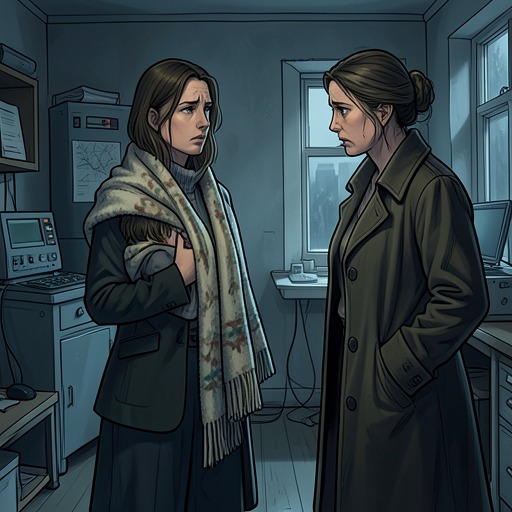
At a later interview, Amaia asks the young mother about the argument at the funeral home. She explains that she had initially preferred cremation but that the baby would ultimately be buried at her amatxi’s request. The dispute began over this question; Valentín pressed the matter so insistently that she had nearly given in. Inés is present as her daughter struggles to explain what followed.
The daughter breaks down, and Inés embraces her. They remain silent together for more than a minute before the young woman pulls away. She then tells Amaia that Valentín had proposed getting her pregnant again immediately so that, in nine months, they would have another child to take the dead baby’s place. She could not forgive what he had said. She insists that no child could replace the one she had lost and that, in the depth of her grief, the idea of having another child for that purpose repelled her. Inés’s embrace is a simple but consequential counterpoint to Valentín’s proposed substitution: in this scene, she makes space for her daughter’s grief rather than treating it as a vacancy to be filled.
Amaia’s final question in the interview asks whether Inés or Valentín had any connection with the psychiatrist Berasategui or the Pamplona law firm Lejarreta y Andía. The evidence provided does not give Inés’s answer or establish a connection. Her role therefore remains grounded in what she has actually supplied: a careful, initially doubted account of the night, knowledge of Valentín’s financial demands, and steadfast physical comfort for her bereaved daughter.